

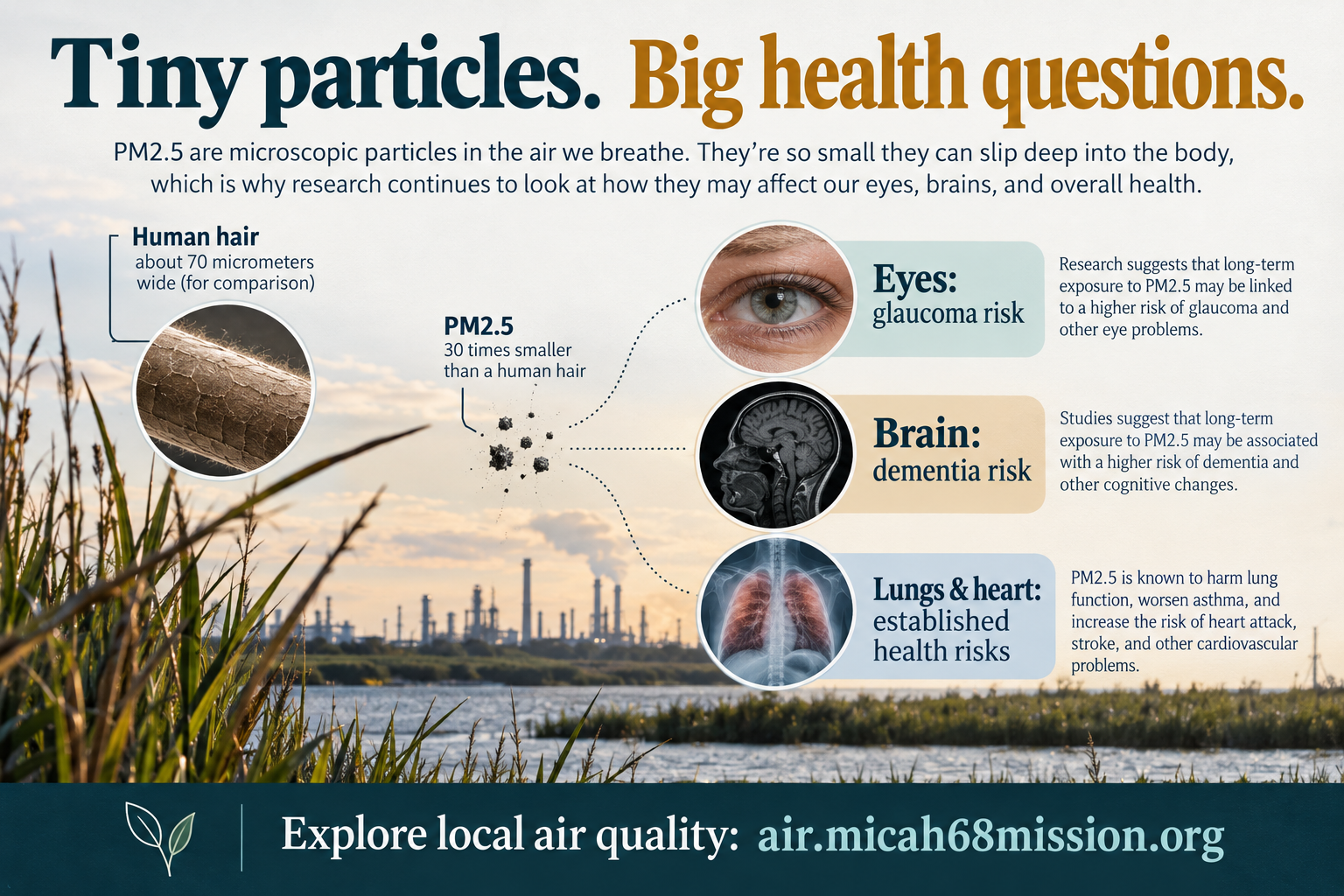
And what does air pollution have to do with our memories? More than you might think.
I subscribe to a number of publications that keep me informed about air, land, and water pollution. Last week, two articles caught my attention—and made my blood boil. Both described research connecting air pollution to serious health problems. At the same time, the EPA is trying to undo stronger protections adopted in 2024. Let me tell you why that matters.
When we talk about air pollution in Southwest Louisiana, most of us think about the smell coming from an industrial facility, smoke rising from an industrial flare, or a cloud drifting from a plant. Thank goodness the Clean Air Act has helped reduce the haze we used to experience.
But some of the most dangerous pollution is too small to see—or smell. It’s called PM2.5, which is just a fancy name for tiny particles floating around in the air. These particles are about 30 times smaller than the width of a human hair. They come from vehicle exhaust, industrial activities, fires, and other sources. Because they’re so small, we can breathe them deep into our lungs. Some particles or their components can even make their way into our bloodstream.
We’ve known for years that PM2.5 contributes to heart and lung disease. But scientists are finding connections to other health problems that may surprise you.
Let’s start with our eyesight. A 2026 review of 18 studies found that people exposed to higher levels of PM2.5 over long periods had an increased risk of glaucoma, a disease that damages the optic nerve and can cause permanent vision loss. Researchers are also investigating links between air pollution and cataracts.[1]
And then there’s our memory. A 2025 review of 28 studies found a significant association between long-term PM2.5 exposure and dementia, including Alzheimer’s disease.[2] Scientists are still investigating why, but inflammation and damage to blood vessels may play a role.
This doesn’t mean everyone exposed to polluted air will develop these diseases. It does mean we have another good reason to take air quality seriously.
What does this mean for Sulphur and Westlake?
Here’s something worth thinking about over your morning coffee: According to Micah 6:8 Mission’s air-monitoring website, more than two out of every three daysduring the past two years recorded daily average PM2.5 readings above 9 micrograms per cubic meter—the level of EPA’s annual health-based standard.[3]
That doesn’t mean those days violated the law. The annual standard is evaluated using longer-term measurements. But it certainly raises questions about what we’re breathing year after year.
And Washington wants to weaken protections?
In 2024, the EPA strengthened the annual PM2.5 standard from 12 to 9 micrograms per cubic meter. Now the current administration is challenging that decision and seeking to overturn the stronger standard, arguing that it was improperly adopted. Although the standard remains in effect, the EPA is pursuing legal challenges while continuing certain required implementation steps under court orders.[4]
Here in Southwest Louisiana, these decisions matter. Cleaner air isn’t just about making our communities smell better. It’s about protecting our hearts, lungs, eyesight, memories, and future health.
Want to know what’s happening in the air around your home?
Visit air.micah68mission.org for local PM2.5 monitoring, historical readings, information about industrial polluters, and resources for reporting air quality concerns.
Take a look. Share it with a neighbor. Ask questions.
Because we can’t protect ourselves from pollution we don’t know about—and we shouldn’t have to figure it out alone.
References
[1] Jain, D., et al. (2026). Ambient Air Pollution and Glaucoma: A Systematic Review and Meta-analysis of Observational Studies.Journal of Current Glaucoma Practice, 20(2), 80–87. Read study.
[2] Burkart, K., et al. (2025). A systematic review with a Burden of Proof meta-analysis of health effects of long-term ambient fine particulate matter (PM2.5) exposure on dementia. Nature Aging, 5, 897–908. Read study.
[3] Micah 6:8 Mission. Air Quality in Southwest Louisiana. Local Sulphur/Westlake PM2.5 monitoring dashboard. Accessed October 2026. View monitoring data.
[4] U.S. Environmental Protection Agency. (October 2, 2026). EPA Notifies States of Potential Designations for the Biden EPA’s Flawed 2024 Air Quality Standard Following Appealed Court Order.Read EPA announcement.
