
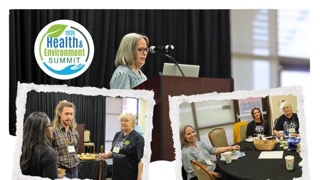
PFAS, disinfectant byproducts and the importance of knowing where your drinking water comes from took center stage during Micah 6:8 Mission’s 2026 Health & Environment Summit.
SULPHUR, LA. — For most people, turning on the faucet is an ordinary part of the day. But speakers at Micah 6:8 Mission’s 2026 Health & Environment Summit encouraged Southwest Louisiana residents to ask a less ordinary question: What is in the water coming out?
Environmental advocate Denise Trabbic-Pointer and Alexander Miele of the Water Collaborative of New Orleans addressed different contaminants and concerns during the Sept. 26 summit, but their presentations shared a common message: residents should have access to clear information about their drinking water and the tools to understand it.
Trabbic-Pointer focused on PFAS, a large family of chemicals known for their persistence in the environment. The strong chemical bonds that make PFAS useful in numerous products can also make it difficult to break down. Exposure can come from consumer products as well as industrial sources, and once released into the environment, the chemicals may reach groundwater, surface water and fish.
Her message for Louisiana was simple: more testing is needed. Trabbic-Pointer urged greater monitoring, particularly in communities near industrial sites, and discussed the historical use of PFAS-containing firefighting foams. She also raised questions about groundwater and the Chicot Aquifer, which supplies much of Southwest Louisiana, while emphasizing the need for additional local testing before conclusions are drawn about individual communities or water systems.
For residents who want to better understand their own water, she encouraged them to begin with their public water system’s water-quality report. Those reports can help residents identify where their water comes from and what contaminants are being monitored. She also discussed point-of-use filtration for drinking and cooking water, stressing that consumers should look for filters specifically tested and certified for the contaminants they are concerned about rather than assuming every filter removes the same substances.
The conversation then shifted from PFAS to another category of drinking-water contaminants: disinfectant byproducts. Miele explained that disinfecting public water with chlorine has been one of the most important advances in preventing waterborne disease. However, when disinfectants react with naturally occurring organic material in water, they can create compounds known as disinfectant byproducts, or DBPs. Two groups commonly monitored in drinking water are trihalomethanes and halo acetic acids.
Miele emphasized that the answer is not to stop drinking water. Instead, water systems must balance the need to kill harmful microorganisms with efforts to reduce unwanted byproducts formed during treatment. Water systems can make changes throughout the treatment process, including removing more organic material before disinfection, changing where treatment chemicals are added, and improving management of the distribution system. Residents can also review their annual water reports and pay attention to advisories from their local systems.
Miele also discussed how statewide water data can sometimes hide problems faced by individual systems, particularly smaller ones. Through his work with the Water Collaborative of New Orleans, he said the organization examines Louisiana drinking-water grades and uses that information to support policy, education and greater public access to water information.
Questions from attendees brought the discussion back home. Participants raised concerns about local drinking-water quality, discoloration, contaminants, and how residents can find reliable information about the water serving their own neighborhoods. The speakers repeatedly returned to the importance of knowing which water system serves a household, reading its reports, and asking questions when information is unclear.
The session also highlighted an important distinction: a concern about drinking-water contaminants does not mean all water is unsafe, and different contaminants require different approaches. What matters is having reliable testing, transparent reporting and information residents can understand.
For Southwest Louisiana communities surrounded by industry and dependent on shared groundwater and public water systems, that information can be particularly important. The takeaway from the discussion was not to fear the faucet, but to know more about it.
Residents can learn where their water comes from, review local water-quality reports, follow public advisories and ask whether additional testing is needed. And when questions remain unanswered, the speakers encouraged communities to continue asking them. Because clean water begins with knowing what is in it.
